Upcoming
EDucation Webinars
Eating Disorders Families Australia delivers twice-monthly EDucation Webinars for families and carers of individuals with eating disorders.
Become a Member
Members can access our online regular webinars for free as part of your membership. You'll need to register for each individual webinar.
Join EDFAWatch Past Webinars
EDFA membership also gives you access to webinar recording after the event. All webinars are recorded, and can be accessed by members after the event.
Watch a RecordingRenowned Eating Disorder Therapist, Carolyn Costin, joined EDFA at an EDucation Webinar. This webinar is freely available to Australian carers to learn more about how to strengthen your loved one’s ‘healthy self’. For access to our full library of recordings, join EDFA today!
Upcoming Webinars
Attendance at our webinar should not be used for professional or financial gain. We ask that you do not promote your own services in the chat or Q&A. Thank you for your cooperation.
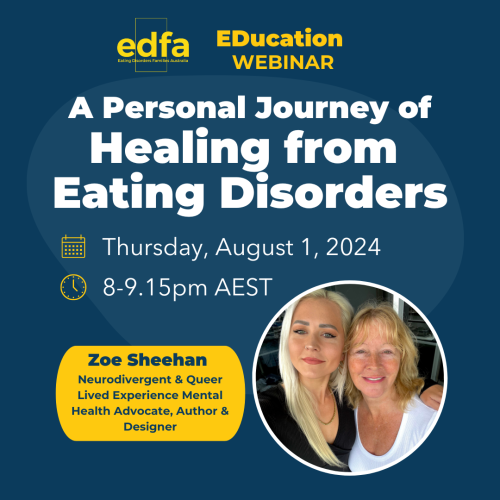
A Personal Journey of Healing from Eating Disorders
Zoe Sheehan
Neurodivergent & Queer Lived Experience Mental Health Advocate, Author & Designer
Thursday, August 1, 8-9.15pm AEST
Join us to hear Zoe Sheehan, a proudly neurodivergent and queer person, who will share her challenging experience of healing from Anorexia Nervosa, Binge Eating Disorder, Bulimia Nervosa & Body Dysmorphia over the course of 13 years. Zoe will also discuss the important role her Mum played in her recovery.
Zoe’s journey included navigating trauma and other challenging life events and will give insight for all carers about how the complexities of underlying feelings and emotions serve to maintain and perpetuate eating disorders and other mental health issues.
Zoe Sheehan is a 27 year old neurodivergent & queer creative working in the media space as a product designer. In 2023 she published her first book, “Neuro the Cookie”. This book tells Zoe’s story about life struggles but in a fun, positive and colourful way. It celebrates diversity, inclusion and shines a positive light on neurodiversity, eating disorders, disabilities and LGBTQIIA+ communities.
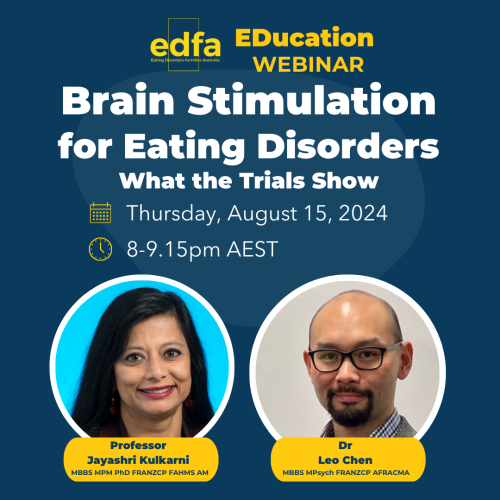
Brain Stimulation for Eating Disorders: What the Trials Show
Professor Jayashri Kulkarni, MBBS MPM PhD FRANZCP FAHMS AM
Dr Leo Chen, MBBS MPsych FRANZCP AFRACMA
Thursday, August 15, 8-9.15pm AEST
Join us to hear the fascinating and promising clinical research trial results of Monash Alfred Psychiatry Research Centre’s (MAPrc) recent Brain Stimulation for Eating Disorders Clinical Trial.
Negative body image affects people of all ages, genders and backgrounds, and is the strongest risk factor for the development of eating disorders.
The existence of effective treatment options for eating disorders is limited. MAPrc is implementing a suite of research focused on understanding the underlying biological causes and changes associated with these disorders so they can translate the findings into innovative and effective treatments. Trials include the use of antipsychotics medications, cannabinoid products, hormone treatment and brain stimulation devices.
Professor Kulkarni has improved the quality of care for women with mental illnesses by developing specific treatments that are tailored to suit women’s needs biologically, socially and psychologically. Dr Chen’s role at MAPrc combines clinical medical/psychiatric, research and teaching activities.
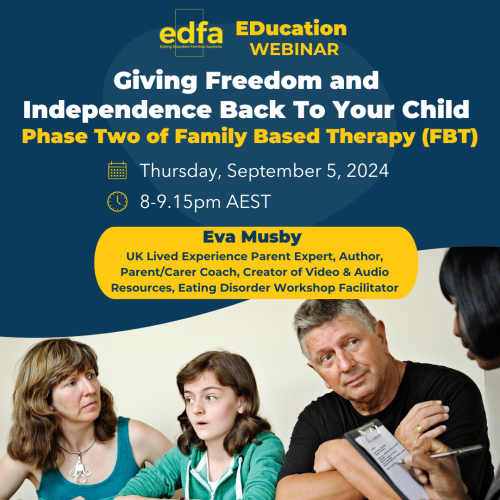
Giving Freedom and Independence Back To Your Child: Phase Two of Family Based Therapy (FBT)
Eva Musby
UK Lived Experience Parent Expert, Author, Parent/Carer Coach, Creator of Video & Audio Resources, ED Workshop Facilitator
Thursday, September 5, 8-9.15pm AEST
In this discussion, Eva Musby will help carers to understand how to get your child to age-appropriate independence and autonomy. Eva will guide carers through a risk management approach, to get clarity and confidence, as well as the courage and wisdom to bear some of the uncertainties.
Up until now your child may have made progress because you have made decisions for them, you’ve given them lots of support and provided supervision.
- How and when can you step back?
- How do you safely hand back decision-making to your child?
- How do you know if it’s ‘too much, too soon’?
- How much supervision and containment does your child still need?
- Can they safely go on a camp or school trip without you? Are they ready to leave for college or university?
If you don’t experiment and take some risks, you’ll forever be managing your child’s life. On the other hand, you’re likely to see a downturn if:
- You give too much freedom, before they have the capability to manage themselves
- Your child’s safety net has been irreversibly thrown away.
This workshop will cover the practical how-to’s of managing risk, and help you think about how you might guide your child towards freedom.